Similar triangles
- CBSE · NCERT Class 10, Ch 6 Triangles
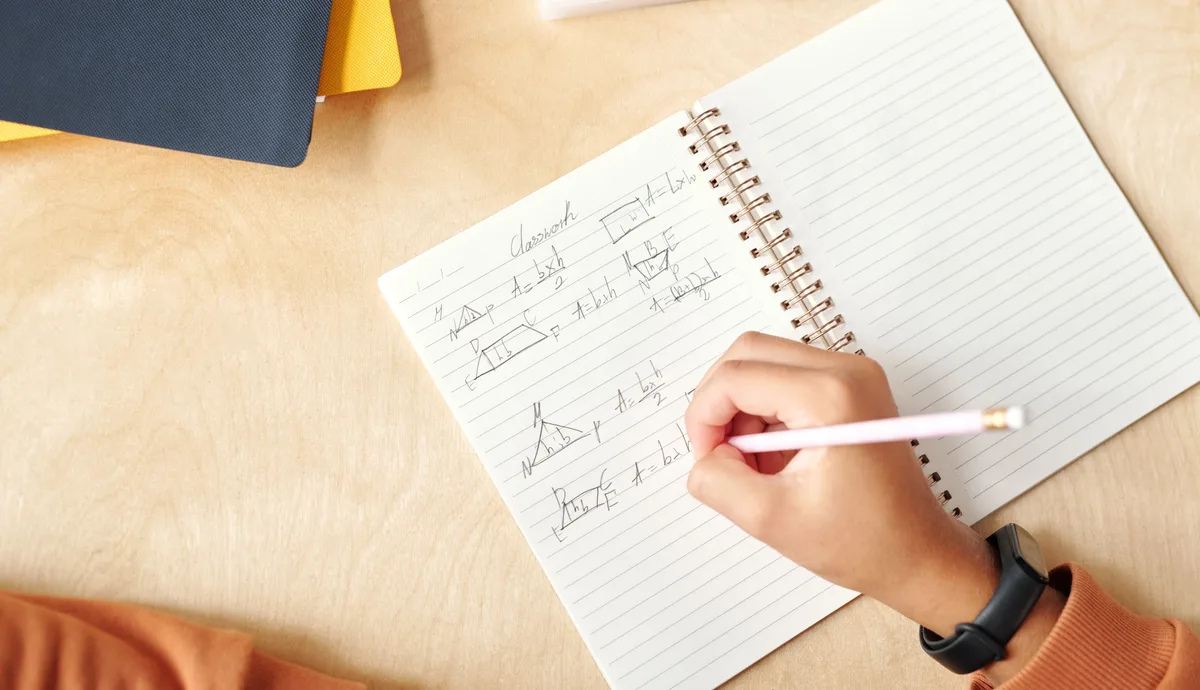
Two triangles are similar when they have the same shape: each angle matches its partner, and every side is the same multiple of its partner.

Similar triangles have the same shape but may differ in size. One is a scaled copy of the other. The symbol for similar is ∼. So ∆ABC ∼ ∆PQR means A matches P, B matches Q and C matches R. The order of the letters tells you which sides pair up.
Because the sides share one ratio, so do the perimeters. If each side is double its partner, the perimeter is double too.
A small example
∆ABC ∼ ∆PQR, with AB = 4 cm, PQ = 6 cm and BC = 5 cm. Find QR.
- The ratio of matching sides is AB/PQ = 4/6 = 2/3.
- So BC/QR = 2/3, which gives QR = 5 × 3/2 = 7.5 cm.
Where marks go
Question 22(B) of CBSE's 2026-27 Maths Standard sample paper gives ∠PQR = ∠QSP, PQ = 6 cm and PS = 3 cm. It asks for PR. The board's Maths Standard marking scheme for 2026-27 gives 1 mark for showing ∆PRQ ∼ ∆PQS by the AA criterion. Half a mark is for the ratio PQ/PS = PR/PQ, and half a mark for PR = 12 cm.
So half the marks come before any number is found. The criteria for similarity decide that first mark. Writing the triangles in the wrong order pairs the wrong sides, and the ratio no longer matches the scheme. Read more on how step marking works.
Sources
Facts last checked against these sources on 30 September 2026.
About the author

Chief Architect
An engineer (B.Tech, Computer Science) with over 20 years of preparing students for entrance exams, including as Dean at FIITJEE and Vice-President at Aakash. He is the chief architect of the TRUpreBoards evaluation engine.
Mohit Sardana on LinkedIn