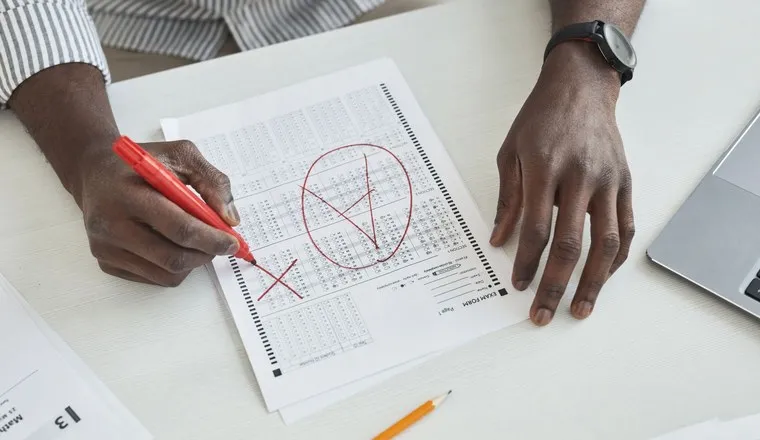
Step marking: does CBSE give marks for steps?
Yes. CBSE splits a question's marks across the steps of the answer. How the split works, with real examples from the board's own marking schemes.

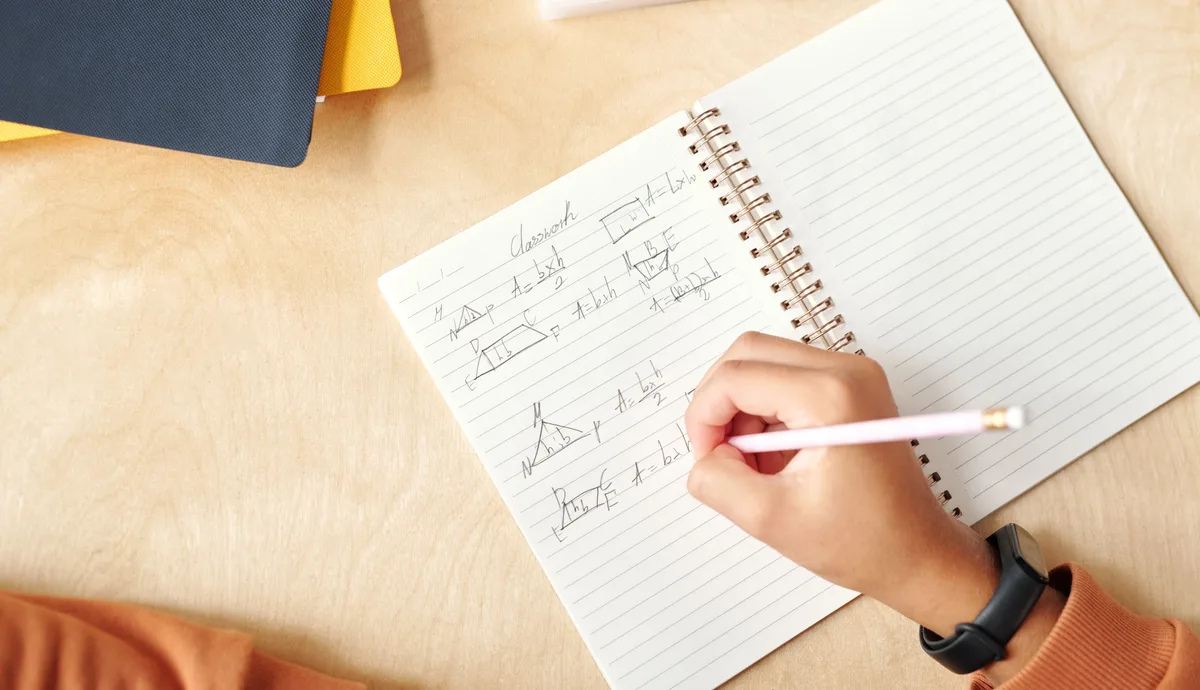
Yes. CBSE gives step marking in Class 10. Step marking means marks for each correct step, not just the final answer. The board's marking scheme splits every long answer into steps and fixes the marks for each. So a wrong final answer can still earn the marks for the steps before it.
What is step marking?
Step marking is a way of giving marks part by part. The examiner does not ask only one question: is the answer right? The examiner asks it of each step. Each step that is correct earns its own share of the marks.
The shares come from the marking scheme - the board's list of what earns marks in each answer. CBSE's Examination Bye-Laws say the scheme shows the value points for each answer. They also say it shows the marks for each value point. A value point is one thing the examiner looks for. Our guide to what a CBSE marking scheme contains shows how to read one.
How does step marking work in CBSE?
It works by splitting the marks, in steps as small as half a mark. Take Question 28(A) of CBSE's own Class 10 Maths Standard sample paper for 2026-27. It asks for the number of sides of a polygon, and it carries 3 marks. The board's marking scheme splits those 3 marks like this:
- 1 mark for setting up the right equation from the rule for adding terms of a series.
- 1 mark for solving it down to (n + 15)(n - 12) = 0.
- Half a mark for the two values, n = -15 or n = 12.
- Half a mark for dropping -15, because a number of sides cannot be negative.
The final answer, 12 sides, carries half a mark. The other two and a half marks sit on the working. A student who writes only "12" has shown one step out of four.

Do you get marks for correct steps if the final answer is wrong?
Yes, if the steps are correct and the method is right. CBSE's Handbook of Assessment and Evaluation says it plainly. "Method marks are to be awarded if the method is correct, even if the answer is not". It adds that method marks are not lost for slips in adding, algebra or units.
The board's 2026 marking schemes carry a rule for examiners that protects later steps too. It reads: "No marks to be deducted for the cumulative effect of an error. It should be penalized only once". So one early slip costs the marks for that step. It should not cost every mark after it.
The handbook is a guide for people who write CBSE papers. The rule for any real question is the marking scheme for that paper. Where the two differ, the paper's own scheme decides.
How many marks for formula and substitution in Class 10?
There is no fixed number for every question. Each question's scheme sets its own split. Question 24 of the same 2026-27 sample paper shows one such split. It asks for the area of a sector, and it carries 2 marks:
- Half a mark for finding the radius, 14 cm, from the diameter of 28 cm.
- 1 mark for the formula with the numbers put in: half of 22 times 14.
- Half a mark for the answer with its unit, 154 cm².
Notice the middle step. The mark is for the formula used on this question, with the numbers in it. The handbook says quoting a formula alone is not usually enough. The formula has to be applied, for example by putting in the values.
Does CBSE give step marks in Maths only?
No. Science answers are split into value points in the same way. In the 2026-27 Science sample marking scheme, Question 16(B) asks about breathing in. Naming it earns 1 mark. Then four points earn half a mark each. The ribs lift, the diaphragm flattens, the chest gets bigger and air is drawn in. Leave one point out and that half mark is lost, even if the rest is perfect. Our look at where the marks go in CBSE Class 10 Science shows how this plays out across a whole paper.
ICSE students are told the same thing in different words. CISCE's 2025 report on the ICSE Maths paper asks candidates to show "all steps of working" beside the answer. It also says: "Do not skip important steps". That report does not print a step-by-step split of marks, so this page does not claim one for ICSE.
Why can a correct answer with no working lose marks?
Because most of the marks sit on the steps, and the examiner can only mark what is written. A step done in your head is not on the page. There is nothing there to award.
Sometimes a correct answer does show the method was used, and the handbook allows for that. But you cannot count on it. Writing the steps is the only sure way to claim them. This gap between what a student knew and what the page shows is where marks that were really known get lost.
What does step marking mean for how you write answers?
- Write every step, even the one that feels too easy to write. It may carry half a mark.
- Put the numbers into the formula on the page. In the sector question above, this line earns 1 of the 2 marks.
- Write the unit with the final answer. In the sector question, the answer line carries its own half mark.
- If you run out of time, write the steps you know. A question left blank earns nothing. A question started can still earn its first steps.
- In Science, check the question for how many points it wants. Each point may be a separate half mark.
How can teachers use step marking in class?
Mark practice papers with the board's sample marking scheme, not with an answer key. An answer key shows only whether the final answer matched. The marking scheme shows which steps earned marks before the answer went wrong. That tells a student whether to work on the method or on care in working.
Give the halves in the order the scheme lists them. Where a student's wording differs from the scheme, ask if it makes the same point. The board's own instructions to examiners ask exactly that. Our page on why two examiners can give different marks explains where that judgment comes in.
How does the rest of the marking process work?
Step marking is one part of how a board paper is marked. Before an examiner sees it, the answer book is coded so the examiner does not know whose it is. Our page on whether examiners know whose answer sheet it is covers that. For the full path from the exam hall to the result, read how your answer sheet is actually checked.
What is not being claimed here?
This page quotes CBSE's sample marking schemes, its handbook and its 2026 instructions to examiners. The exact split for a question in a real exam is set in that exam's own scheme. Where this page and the board's scheme differ, the board's scheme is right. Nothing here counts how often marks are lost, because no scripts were counted for it.
Sources
Facts last checked against these sources on 30 September 2026.
- Class X Sample Question Papers and Marking Schemes, 2026-27 · CBSE Academic Unit
- Mathematics Standard (041) Marking Scheme, Class X 2026-27 - Questions 24 and 28(A) · CBSE Academic Unit
- Science (086) Marking Scheme, Class X 2026-27 - Question 16(B) · CBSE Academic Unit
- Board exam marking schemes, 2026 - General Instructions to examiners (Science 086, Mathematics Basic 241) · CBSE
- Handbook of Assessment and Evaluation (2021) - method, accuracy and follow-through marks, page 64 · CBSE
- Examination Bye-Laws (1995, updated to December 2004) - rule 52, the marking scheme · CBSE
- ICSE Analysis of Pupil Performance, Mathematics, October 2025 - suggestions for candidates · CISCE
About the author

Chief Architect
An engineer (B.Tech, Computer Science) with over 20 years of preparing students for entrance exams, including as Dean at FIITJEE and Vice-President at Aakash. He is the chief architect of the TRUpreBoards evaluation engine.
Mohit Sardana on LinkedIn