Is CBSE checking strict? Why two examiners can differ
CBSE asks examiners to mark by the scheme, not by feel, and puts checks around them. Where two examiners can still differ, and what you can do after results.

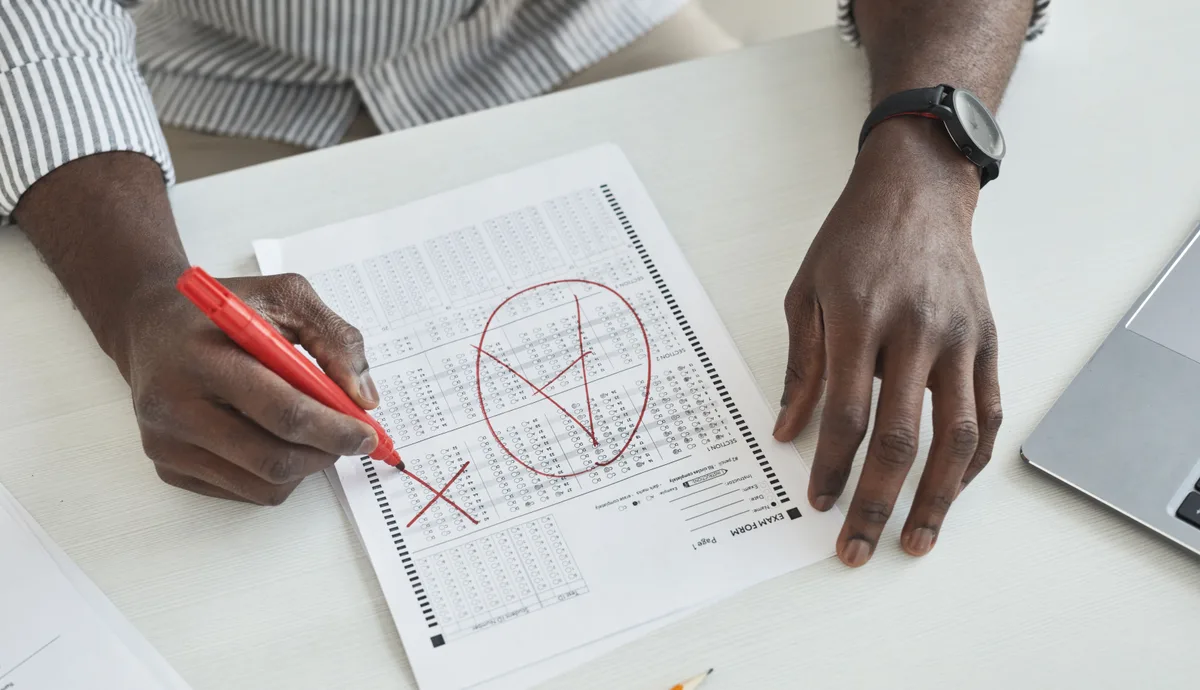
CBSE checking is meant to be neither strict nor lenient. Examiners are told to mark by the board's marking scheme, not by their own view. A head examiner checks each examiner's first answer books. Two examiners can still differ where an answer needs judgment, such as an answer written in the student's own words.
Is CBSE checking strict or lenient?
Neither, by design. CBSE publishes no measure of how strict its checking is. What it does publish is the set of rules examiners mark by. They are printed at the top of every board-exam marking scheme, and the 2026 ones point both ways.
They tell examiners not to mark by their own reading. Marking "should not be done according to one's own interpretation or any other consideration". They also tell examiners not to hold marks back: "Please do not hesitate to award full marks if the answer deserves it". An answer that is totally wrong gets a cross and zero.
So the honest answer is that checking is as strict as the marking scheme. A step the scheme gives marks for should earn them. A step it does not name earns nothing, however neat.
Can two examiners give different marks for the same answer?
Yes, they can, and CBSE says so itself. Its Handbook of Assessment and Evaluation names "gaining inter-marker consistency" as a hard part of marking long answers. That means getting different markers to give the same marks.
The same handbook names a second problem: "the halo effects associated with hand-writing, grammar and spelling". A halo effect is when one thing about an answer, like neat writing, colours how the rest is judged. It has nothing to do with whether the science is right.
This is not a charge against examiners. Any system where a person reads a paragraph and decides its worth lives with this. The real question is how much of it the system removes before a mark reaches a child.
One kind of bias is ruled out by design. The examiner is not told whose answer book it is. Read how CBSE keeps a name off the answer sheet for how that works.
Why do different examiners give different marks?
Mostly because some judgment is built in on purpose. The 2026 marking schemes tell examiners that the value points are a guide, not the only right answer:
"The students can have their own expression and if the expression is correct, the due marks should be awarded accordingly."
So the examiner must decide if a student's own words make the same point as the scheme. Two careful people can decide that differently. What the examiner does not decide is how many marks a point is worth. That is printed. It is also why step marking makes marking more even: marks sit on named steps, not on overall impressions.
Plain slips happen too. The 2026 instructions list "common types of errors committed by the Examiner in the past". They include leaving an answer unmarked, adding marks up wrongly and copying them wrongly to the front page.
How are CBSE examiners chosen and checked?
Under CBSE's Examination Bye-Laws, a Class 10 examiner must hold a degree in the subject. They need at least three years of teaching. They must be a practising teacher of that subject, or a retired one under 65.
A head examiner sits above each group. The Bye-Laws make that person "responsible for ensuring uniform evaluation of answer books as per the final marking scheme". They set one head examiner for every 10 to 15 examiners. They also allow the head examiners to change the marking scheme after marking sample answer books.
The 2026 marking schemes add a check on the first day. The head examiner reads the first five answer books each examiner marks. Only when there is no large gap between examiners do they get the rest. On any gap the instruction is plain:
"If there is any variation, the same should be zero after deliberation and discussion."

The Bye-Laws quoted here are the 1995 edition, updated to December 2004. It is the version CBSE publishes in a form that can be read. The first-five check comes from the 2026 marking schemes. Whether every older rule still applies unchanged, this page cannot confirm.
How are CBSE examiners trained?
The public record says little about training. The 2026 marking schemes tell examiners to read the "Guidelines for Spot Evaluation" before they start. This page has not seen those guidelines, so it does not describe them.
What can you do if you think a mark is wrong?
You can ask the board to look again, but not straight away. Under the two-exam notice for Class 10, three options open only after the second exam's results. They cover both exams. In 2026 you first got a copy of your answer book. With it, you could ask for the totals to be checked, a fresh look at chosen answers, or both.
They are not the same thing. A totals check, called verification, only checks that every answer was marked and added up right. The Bye-Laws say plainly that it does not re-mark anything. Our page on photocopy, verification and re-evaluation sets out all three. Whether asking is likely to help is covered in is re-evaluation worth it.
What does this mean for a student writing the paper?
The marks you control best are the ones the scheme prints. Write the steps the scheme is likely to name, in order, where the examiner can find them. Each clear step is one less judgment call, and judgment calls are where marks can differ.
Write clearly too. Handwriting earns no marks of its own. But the handbook lists it among the things that can pull on a marker's judgment. For how an examiner reads a real answer, see how examiners give marks, step by step.
Sources
Facts last checked against these sources on 30 September 2026.
- Board exam marking schemes, 2026 - General Instructions to examiners (Science 086, Mathematics Basic 241) · CBSE
- Examination Bye-Laws (1995, updated to December 2004) - marking scheme, head examiners, examiners, verification of marks · CBSE
- Handbook of Assessment and Evaluation (2021) - consistency between markers and the halo effect · CBSE
- Notification: Two Board Examinations in Class X from 2026 (25.06.2025) - post-result facilities · CBSE
About the author
Chief Architect
An engineer (B.Tech, Computer Science) with over 20 years of preparing students for entrance exams, including as Dean at FIITJEE and Vice-President at Aakash. He is the chief architect of the TRUpreBoards evaluation engine.
Mohit Sardana on LinkedIn