How board papers are checked, step by step
Who checks a CBSE board paper, where it goes, and how each answer is marked against the scheme - from the exam hall to the result.

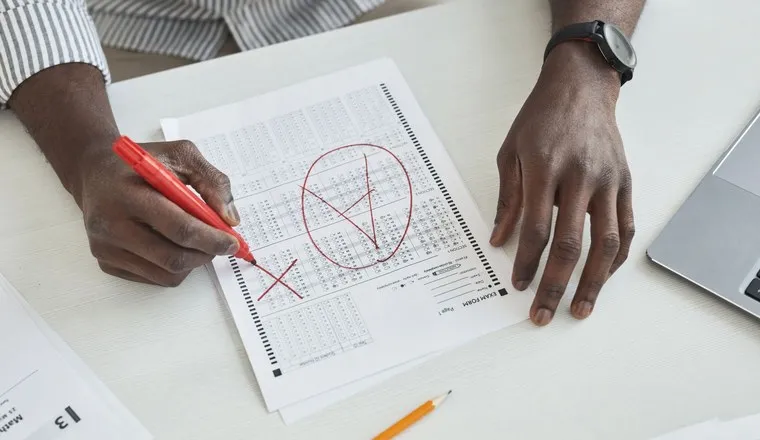
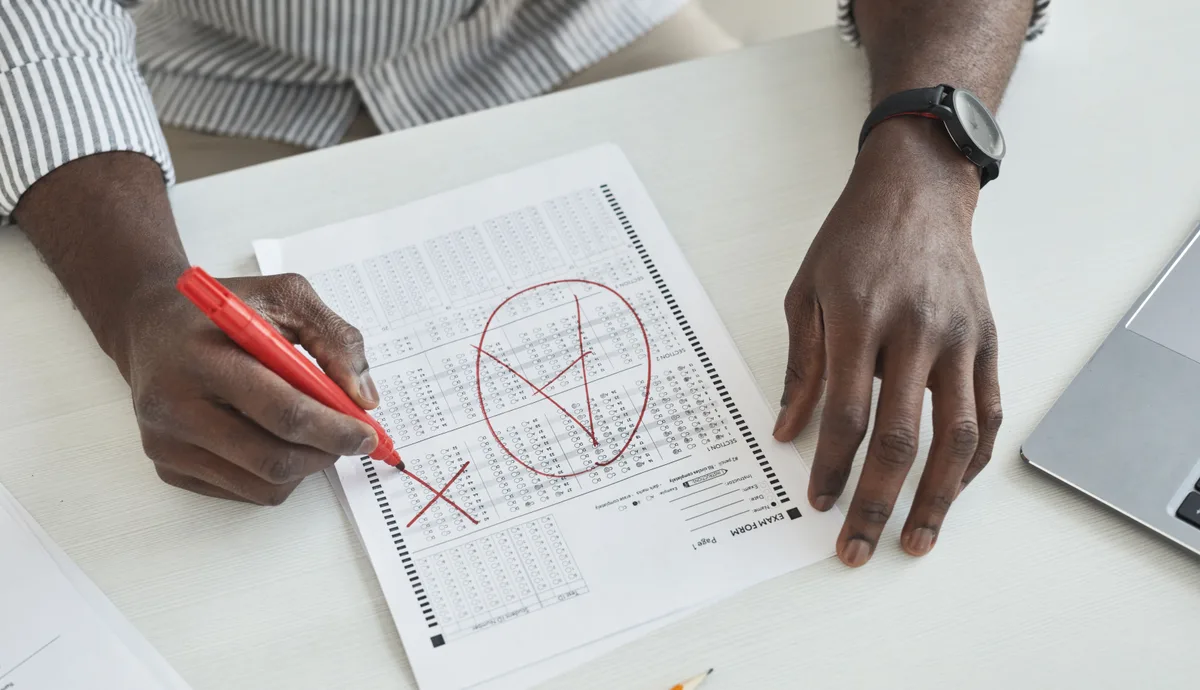
CBSE answer sheets are checked by subject teachers appointed as examiners. They mark each answer against the board's marking scheme, step by step. Before marking, each roll number is swapped for a code, so the examiner does not know whose paper it is. A head examiner checks their work, and the marks are then totalled.
What happens to your answer sheet after the exam?
It leaves the exam centre and goes to the board. CBSE's Examination Bye-Laws say the answer books are received by the board's Regional Officer, or an officer approved for the job. From then on they are "confidential" documents. Only people named by the board may handle them.
Next, the answer book is coded. Secrecy officers change each real roll number to a fictitious number - a made-up code. Only then does it go for marking. Our page on whether examiners know whose answer sheet it is explains the coding in full.

Where do CBSE Class 10 papers go for checking?
To an evaluation centre, usually a school. The Bye-Laws say the board picks the cities and centres where answer books are marked. They add that these "spot evaluation centres" are normally in schools affiliated to CBSE.
The Bye-Laws also describe a "nodal centre". This is a school with room to store answer books safely and to seat examiners. It sits centrally among about ten schools, with staff nearby who can act as examiners.
The 2026 marking schemes still refer to "spot evaluation". The rules do not say which centre marks any one student's paper, and this page does not guess.
Who checks CBSE board papers?
Teachers of the same subject. Under the Bye-Laws, a Class 10 examiner must hold a degree in the subject and have at least three years of teaching. They must be a practising teacher of that subject, or a retired one under 65. Nobody may examine two subjects at the same time.
Above each group of examiners is a head examiner. This is a senior teacher, such as a principal or a senior subject teacher. The Bye-Laws set one head examiner for every 10 to 15 examiners. If more than five examiners are marking on a day, an assistant is added, called an additional head examiner.
How are CBSE Class 10 answer sheets marked?
Against the marking scheme, one part at a time. The scheme splits each question's marks into value points or steps. That is called step marking. See how step marking splits a question's marks. The instructions printed at the top of each 2026 board-exam marking scheme tell examiners how to do it:
- Follow the scheme. Marking "should not be done according to one's own interpretation".
- Accept correct answers in the student's own words. The value points are a guide, not the only right answer.
- Tick what is right, cross what is wrong. A tick with no marks is listed as a common examiner error.
- Mark each part, then total the question. Part marks go on the right. The question total goes in the left margin, circled.
- Cut marks for an error only once. A slip should not cost marks again in the steps that follow it.
On the first day, the head examiner reads the first five answer books each examiner marks. Examiners get the rest only when there is no large gap between them. The full set of rules is on CBSE's marking scheme page, at the top of each subject's scheme.
How are marks added up and checked?
The examiner must make sure every answer is marked. The marks are carried to the front page of the answer book, which the board calls the title page. There they are totalled and written in both figures and words.
The 2026 instructions also list "common types of errors committed by the Examiner in the past". They include an answer left unmarked, wrong adding up, and marks copied wrongly to the front page. The list exists so that examiners avoid these slips.
The examiner marks what is written, against a scheme that was set with the question paper.
Is a Class 10 answer sheet marked on a computer screen?
This page found no official CBSE notice saying Class 10 answer books are marked on screen. The 2026 Class 10 marking schemes tell examiners to write marks in the margins of the answer book. If CBSE announces a change for Class 10, this page will say so, with the notice.
What does this mean for the student writing the paper?
The examiner can only mark what is on the page, against a scheme they must follow. So the way an answer is written matters as much as what the student knows. The marking scheme for each subject shows what the examiner will look for.
- Show every step. A step done in your head is not on the page, so there is nothing to mark.
- Write the question number clearly. The examiner must match each answer to its question in the scheme.
- Cross out rough work with one clean line. That keeps the page easy to read and shows what you want marked.
- Do not write your name anywhere inside. The Bye-Laws treat it as unfair means.
Marks lost this way are marks the student could have earned. Our guide to why students lose marks they actually knew goes through the common ways it happens.
Is the checking process fair?
It is built to be consistent. Coding takes away the examiner's knowledge of who the student is. A shared scheme and a head examiner's checks narrow the room for personal views. Some room for judgment remains on purpose, as our page on why two examiners can give different marks explains.
Can you see your checked answer sheet?
Yes, but only after the second board exam's results, for Class 10. The CBSE notice on two board exams says the copy, the totals check and a fresh look at answers open only then. They cover both exams. Our page on photocopy, verification and re-evaluation sets out each one.
What is not being claimed here?
The Bye-Laws quoted here are the 1995 edition, updated to December 2004. It is the version CBSE publishes in a form that can be read. The marking rules come from the 2026 marking schemes. This page makes no claim about how fast examiners mark, how many papers they mark, or how often errors happen.
Sources
Facts last checked against these sources on 30 September 2026.
- Examination Bye-Laws (1995, updated to December 2004) - receipt, coding and evaluation of answer books, examiners · CBSE
- Board exam marking schemes, 2026 - General Instructions to examiners (Science 086, Mathematics Basic 241) · CBSE
- Notification: Two Board Examinations in Class X from 2026 (25.06.2025) - post-result facilities · CBSE
About the author
Chief Architect
An engineer (B.Tech, Computer Science) with over 20 years of preparing students for entrance exams, including as Dean at FIITJEE and Vice-President at Aakash. He is the chief architect of the TRUpreBoards evaluation engine.
Mohit Sardana on LinkedIn