CBSE rechecking: is re-evaluation worth it?
CBSE marks can go up or down after re-evaluation, and the new mark stands. Get the scanned copy first, then decide which questions to put forward.

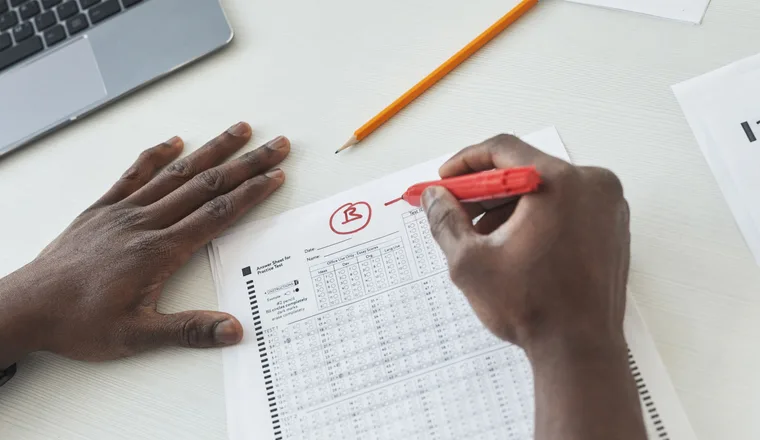
Yes, CBSE marks can go up after re-evaluation (also spelt revaluation). They can also go down, and either way the new mark stands. So get the scanned copy of the answer book first. Re-evaluation is worth it when that copy shows a whole question where the answer matches the marking scheme but the marks do not.
Can marks increase after rechecking in CBSE?
Yes. CBSE's 2026 notice on post-result facilities for Class 10 says revised marks "may increase, decrease or remain unchanged". If marks go up, CBSE refunds the fee for that check.
There are two kinds of check. Verification of marks looks at the totals: was every answer marked, and were the marks added and copied correctly? Re-evaluation is a fresh look at whole questions you choose, against the marking scheme.
Can marks decrease after re-evaluation in CBSE?
Yes. The notice says a decrease of even one mark will be applied. The result of the check is final, and CBSE takes no appeal against it.
This is why the decision matters. Re-evaluation is not a free second try. A fresh reading can find marks that were missed. It can also find marks that were given too freely.
Re-evaluation is meant for a question you can point at, not for a subject that disappointed you.
What should you check on the scanned copy?
In 2026, CBSE gave the scanned copy of the answer book first. Only students who had it could then ask for verification or re-evaluation. Photocopy, verification and re-evaluation explains how to get it. CBSE's own notice suggests what to look for.

- Are all the extra sheets there? Check that every extra answer sheet you used, called a supplementary answer book, is in the scanned copy. CBSE's own guidance lists this check first.
- Is every answer marked? Look for a question with no mark next to it, such as an answer carried on to a later page.
- Do the step marks add up? CBSE's own example: a question has step marks of 1, 1 and 1, but only 2 is written in the margin. That is a totalling slip.
- Were the marks copied right? Check each answer's mark against the table on the cover, then the column total against the result.
These are checks of the totals. They need no view on whether an answer was good.
When is re-evaluation worth it?
When a whole question looks under-marked against the scheme. Take the question paper and the marking scheme for your child's set. Both are on CBSE's website. Mark the answer yourself against the scheme.
Marks are given for each step. How step marking works explains this. So look for steps that are on the page but have no marks. Say the formula and the working are both written, and the question scored zero. That is a clear case you can name.
Re-evaluation covers the full question, not part of it. You must also give a reason for each question you pick. A clear reason is the one you can point to on the page.
When is it not worth applying?
- The marking looks fair. Every answer is marked, the totals are right, and marks were lost where the answer fell short. The copy has done its job.
- The step was done in the head. A step never written down has nothing on the page to mark. A second reader will find the same gap.
- You disagree with the scheme itself. Re-evaluation checks whether the scheme was applied. It does not change how many marks the board gives a step.
A fair copy is still worth a lot. It shows where the marks went, question by question. If your child has lost marks on steps they knew but did not write, the copy shows exactly where.
What are CBSE re-evaluation fees per question?
For the 2026 Class 10 results, the notice set these fees:
- Scanned copy: Rs 300 per subject.
- Verification of marks: Rs 300 per answer book.
- Re-evaluation: Rs 100 per question, including all its parts.
Everything is applied for and paid online. Each step can be applied for only once, so choose all your subjects and questions together. Fees are set again each year, so check the notice for your year.
When can you apply?
For Class 10, only after the second board exam's results, for both exams together. In 2026, those results came on 18 July, and the notice for the copies came on 5 August. So the marked copy cannot help decide whether to sit the second board exam.
If your child sat a subject in both exams, you can get both copies. But verification and re-evaluation apply to only one of the two answer books. The two board exams explains the wider scheme.
How does rechecking work for ICSE Class 10?
ICSE works in two steps. The CISCE regulations for the ICSE exam allow a recheck, applied for within four days of the results. It checks that every answer was marked and the totals are right.
After the recheck results, a student can ask for re-evaluation within three days. The new marks, higher or lower, are final. The re-evaluation fee is not refunded. CISCE does not let candidates see answer scripts or copies of them. These rules are from CISCE's latest published edition, the one for the 2028 exam. Check the edition for your child's exam year.
So is re-evaluation worth it?
It is worth it for a specific question you can point to. It is not worth it as a general hope for more marks. For the full rules on passing and results, start with what the passing rules actually say.
Sources
Facts last checked against these sources on 30 September 2026.
About the author

Founder Member & Director
An MBA (Finance and Strategy) with over 16 years across strategy, technology and operations. At TRUtesting he makes sure the platform is built to serve schools reliably and at scale.
Prabhjeet Singh on LinkedIn